In Stock
Share your international phone number to discuss pricing and delivery:
Buy this product in 1 click:
Or contact us directly via:


Share your international phone number to discuss pricing and delivery:
Or contact us directly via:
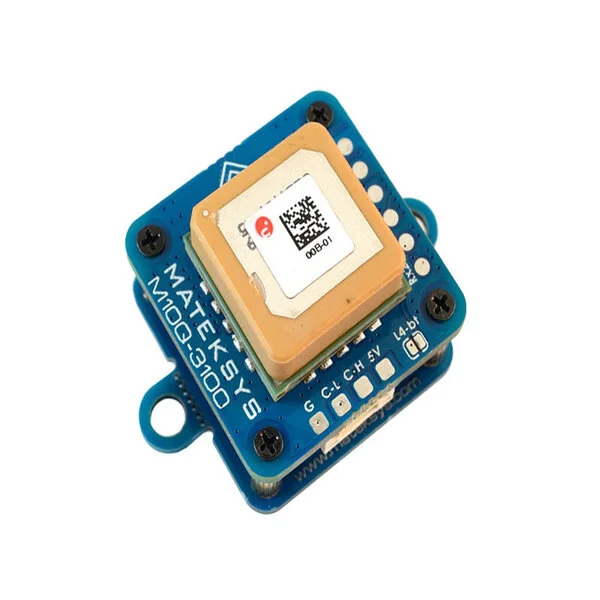
The Matek M10Q-3100 is a high-performance GNSS + Compass module integrating a u-blox M10 series multi-constellation GNSS receiver and a PNI RM3100 industrial-grade magnetometer. It provides precise position and heading data for drones, robotics, and other navigation systems. The module supports CAN (DroneCAN) and UART/MSP interfaces, features a compact design, and ensures strong anti-jamming performance with its 15 × 15 mm high-gain patch antenna.
Table 2-1. M10Q-3100 GNSS + Compass Specifications
| Manufacturer | Matek Systems |
| Model | M10Q-3100 |
| GNSS Chipset | u-blox M10 (GPS, GLONASS, Galileo, BeiDou) |
| Compass Sensor | PNI RM3100 magnetometer |
| Interface | CAN (C-H, C-L, DroneCAN protocol), UART/MSP |
| Supply Voltage | 4.5 V – 5.3 V (nominal 5 V) |
| Current Consumption | ≈ 50 mA (typical) |
| Patch Antenna | 15 × 15 mm ceramic high-gain antenna |
| Dimensions | 36 × 15 × 16 mm |
| Weight | ~12 g |
| Operating Temperature | -20 °C ~ +85 °C |
| Firmware Support | ArduPilot AP_Periph / PX4 CAN peripheral |
Table 3-1. Power and Signal Parameters
| Parameter | Min | Typ | Max | Unit |
|---|---|---|---|---|
| Supply voltage (VCC) | 4.5 | 5.0 | 5.3 | V |
| Operating current | - | 50 | 60 | mA |
| CAN interface voltage | - | 5.0 | - | V |
| UART interface voltage | 3.3 | 3.3 | 5.0 | V |
Table 4-1. Module Dimensions
| Dimensions (L × W × H) | 36 × 15 × 16 mm |
| Weight | 12 g |
| Mounting Type | Four mounting holes (M2.5) |
| Antenna | Integrated ceramic patch antenna |
NOTE: For optimal GNSS performance, mount the module with clear sky view and avoid interference from high-current circuits.
Table 5-1. GNSS and Compass Performance
| GNSS Constellations | GPS L1, GLONASS L1, Galileo E1, BeiDou B1C |
| Position Accuracy | 2.0 m CEP (open sky) |
| Cold Start | < 26 s |
| Hot Start | < 1 s |
| Reacquisition | < 1 s |
| Compass Resolution | < 0.5° typical (after calibration) |
| Heading Accuracy | ±2° (typical, after field calibration) |
Table 7-1. Environmental Specifications
| Operating Temperature | -20 °C ~ +85 °C |
| Storage Temperature | -40 °C ~ +90 °C |
| Vibration Resistance | IEC 60068-2-6 compliant |
| Humidity | 5 % ~ 95 %, non-condensing |
There are no reviews for this product.
There are no reviews for this product, be the first to leave your review.
No questions about this product, be the first and ask your question.