In Stock
Share your international phone number to discuss pricing and delivery:
Buy this product in 1 click:
Or contact us directly via:


Share your international phone number to discuss pricing and delivery:
Or contact us directly via:
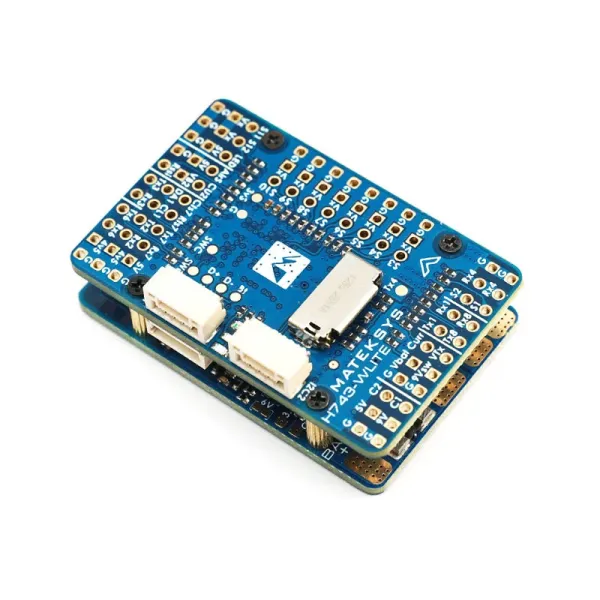
The Matek Systems H743-WLITE is a compact and high-performance flight controller designed for fixed-wing, VTOL, and large UAV aircraft. It is based on the STM32H743VIH6 480 MHz microcontroller and integrates IMU ICM42688-P and DPS310 barometer. This controller supports advanced flight stacks such as ArduPilot and INAV, making it suitable for both hobbyist and professional applications. The WLITE version includes a built-in Power Distribution Board (PDB) and current sensor for simplified installation and power monitoring.
Table 2-1. H743-WLITE Technical Specifications
| Manufacturer | Matek Systems |
| Model | H743-WLITE Flight Controller |
| MCU | STM32H743VIH6 (480 MHz, H7 series, 2 MB Flash) |
| IMU | ICM42688-P |
| Barometer | DPS310 |
| OSD | AT7456E Integrated On-Screen Display |
| UART Ports | 7 (UART1–8 depending on mapping) |
| I²C Buses | 2 |
| CAN Bus | 1 |
| PWM Outputs | 12 or 13 (12 PWM + LED pad) |
| ADC Inputs | 6 (VBAT, Current, RSSI, Airspeed, VB2, CU2) |
| Input Voltage Range | 6.8 V ~ 30 V (2S ~ 6S LiPo) |
| Current Sensor | 90 A continuous / 220 A peak (shunt ≈ 0.3 mΩ) |
| Power Outputs | 5 V / 9 V / 12 V / Vx BEC channels (2 ~ 8 A depending on rail) |
| Dimensions | 44 × 29 × 14.5 mm (integrated PDB version) |
| Weight | ≈ 22 g (with USB adapter and buzzer) |
| Firmware | ArduPilot / INAV (“MATEKH743” target) |
Table 3-1. Electrical Parameters
| Parameter | Min | Typ | Max | Unit |
|---|---|---|---|---|
| Input Voltage | 6.8 | 12 | 30 | V |
| Continuous Current (PDB) | – | 90 | – | A |
| Peak Current (PDB) | – | – | 220 | A |
| 5 V BEC Output | 4.8 | 5.0 | 5.2 | V |
| 9 V BEC Output | 8.8 | 9.0 | 9.3 | V |
| 12 V BEC Output | 11.8 | 12.0 | 12.3 | V |
| Operating Temperature | -20 | 25 | 80 | °C |
Table 5-1. Environmental Ratings
| Operating Temperature | -20 °C ~ +80 °C |
| Storage Temperature | -40 °C ~ +90 °C |
| Humidity | 5 % ~ 95 % (non-condensing) |
There are no reviews for this product.
There are no reviews for this product, be the first to leave your review.
No questions about this product, be the first and ask your question.